
 Contact Us
 Refer a Patient
 Pay My Bill
Macular Degeneration
The eye doctors at Fraser Eye Care in Detroit, Michigan have experience in treating a range of retinal conditions and diseases, including macular degeneration. Through early diagnosis and prompt treatment of macular degeneration, we can help preserve patient’s eye health and vision.
What is Macular Degeneration?
The retina is located at the back of the eye: it is a layer of cells that sends light to the optic nerve, where it is converted into images. Age-related macular degeneration (AMD) is an eye condition that causes degeneration of the macula, the area of the retina responsible for central vision. This causes slow central vision loss. Peripheral (side) vision is not affected by macular
 Trusted Source
Retina
Cleveland Clinic
Go to Source
degeneration.
Trusted Source
Retina
Cleveland Clinic
Go to Source
degeneration.
AMD is a common condition, and is the
Trusted Source
What is Macular Degeneration?
American Academy of Ophthalmology
Go to Source
leading cause
of blindness in people over the age of 50, according to the American Academy of Ophthalmology.
Types of Macular Degeneration
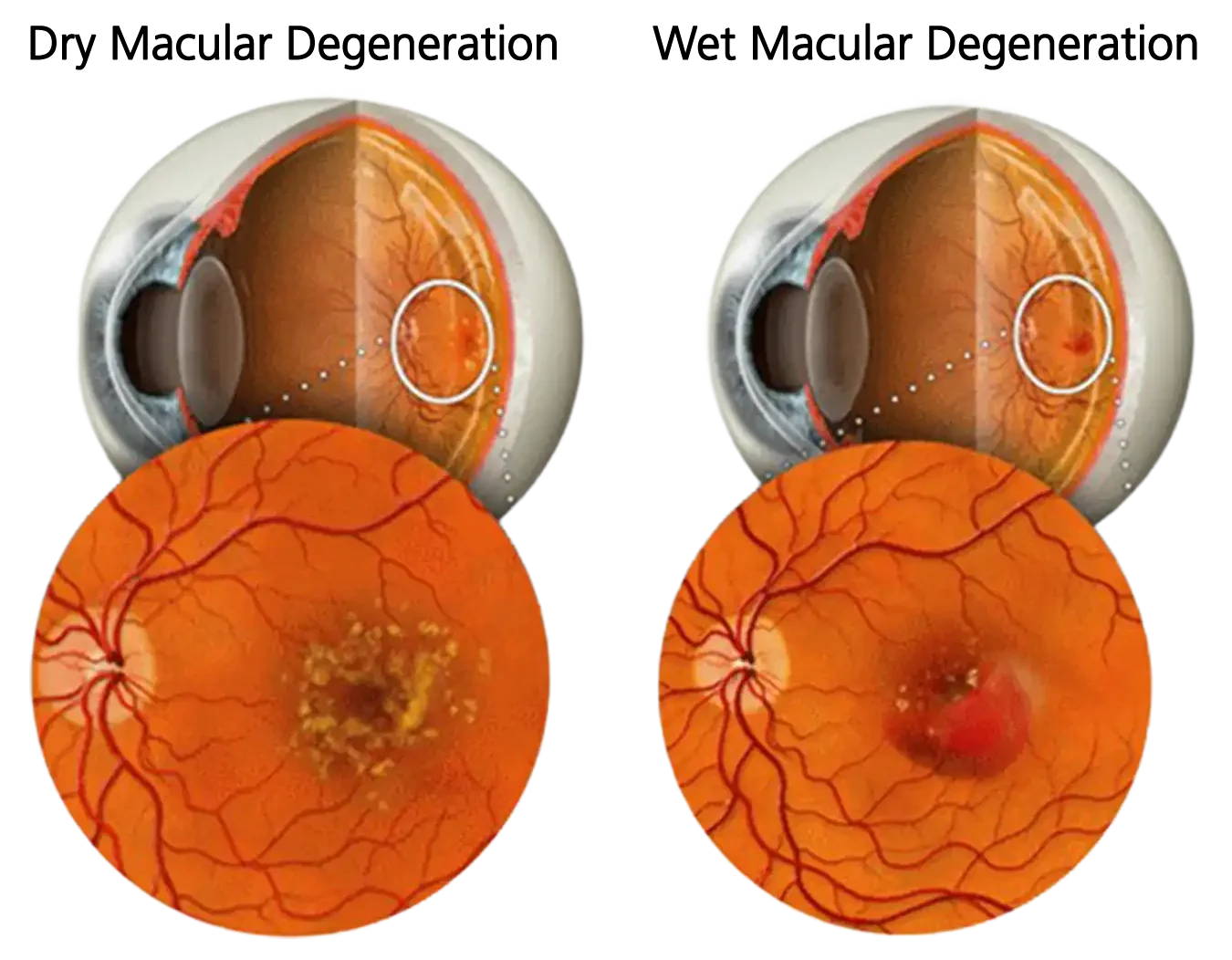
There are two types of macular degeneration: dry macular degeneration and wet macular degeneration.
Dry Macular Degeneration
The dry form of macular degeneration, (non-neovascular or atrophic macular degeneration) is the most common form of this condition by far, affecting up to 90% of patients. Dry macular degeneration is caused by drusen, which are protein deposits that can form under the macula. Over time, this can cause the macula to become thinner and more dry. Patients with dry AMD experience gradual vision loss that rarely results in total blindness. Rarely, dry macular degeneration can progress to wet macular degeneration.
Wet Macular Degeneration
Wet macular degeneration (neovascular or exudative macular degeneration is the result of the formation of abnormal blood vessels under the macula and retina. In wet AMD, the abnormal blood vessels exude blood and fluid, causing the macula to bulge. Loss of central vision in patients with wet AMD can be sudden and
Trusted Source
Age-Related Macular Degeneration
Cleveland Clinic
Go to Source
complete.
Symptoms of Macular Degeneration
When AMD is in its early stages, patients may not encounter any vision problems or other symptoms. As dry macular degeneration progresses, patients may begin to notice:
- Blind spots, dark spots, or shadows in the central vision
- Fuzzy or distorted vision
- Difficulty seeing color
- Difficulty seeing fine details
- Dim vision, especially when reading
If a patient has wet AMD, visual distortion may include straight lines that appear wavy and increasing blind spots. Vision loss from wet macular degeneration can occur very suddenly, even over the course of days.
How is Macular Degeneration Diagnosed?
Age related macular degeneration is a leading cause of vision loss in people over the age of 50. While there is no cure for AMD, it is possible to slow its progression, which is why it is so important to have regular eye exams. If signs of macular degeneration are identified early, prompt treatment can slow or even prevent vision loss.
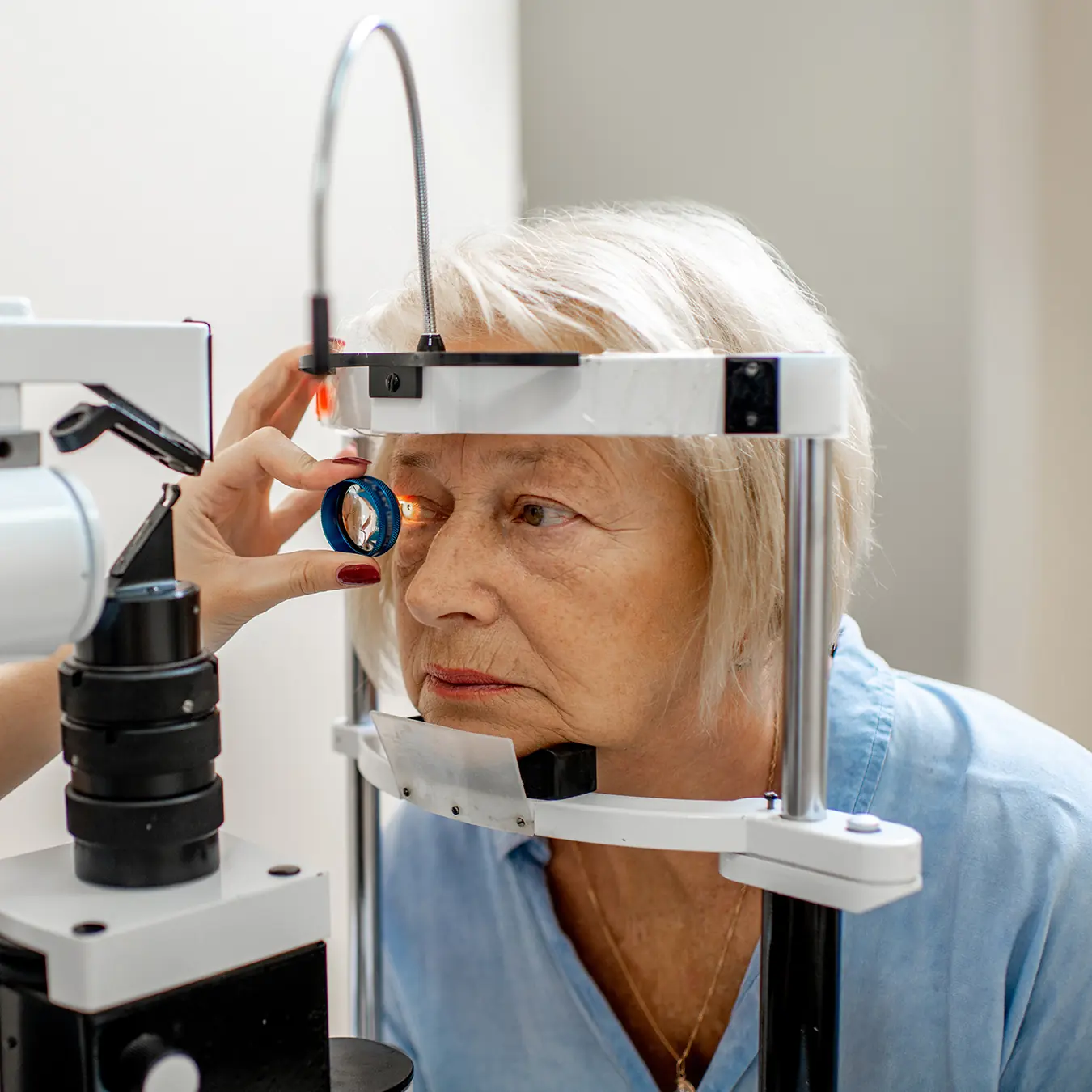
The first step an ophthalmologist will perform to diagnose age-related macular degeneration is a dilated eye exam. Additional tests that will lead to a definitive diagnosis include:
- A visual examination of the back of the eye to look for drusen or abnormal blood vessels
- Visual acuity test
- Fluorescein angiography, where dye is used to make it easier to visualize blood vessels in the eye
- Optical coherence tomography (OCT)
- Amsler grid test to evaluate central
Trusted Source
How is AMD Diagnosed and Treated?
American Academy of Ophthalmology
Go to Source
vision

Stages of Macular Degeneration
Age-related macular degeneration is progressive, and the stages of AMD are classified by signs identified by an eye doctor as well as the patient’s symptoms.
Early Stage Macular Degeneration
Early stage macular degeneration is characterized by a higher-than-usual presence of drusen, or yellow deposits, under the retina. Most patients with early stage AMD do not experience symptoms.
Intermediate Stage Macular Degeneration
In intermediate stage AMD, large drusen and changes in the pigment of the retina can be observed by an ophthalmologist. Visual impairment is usually not present during intermediate stage macular degeneration, though patients may notice small gaps in their vision.
Late Stage Macular Degeneration
When a patient is in late stage macular degeneration, severe retinal damage has resulted in severe vision loss. At this stage of AMD, patients may notice that straight lines appear wavy.
Treatment for Macular Degeneration
There is no cure for AMD, but it may be possible to slow its progression and reduce or prevent vision loss.
The National Eye Institute states that patients with wet AMD may be able to reduce further vision loss by:
- Anti-VEGF (vascular endothelial growth factor) ocular injections
- Laser therapy
- Laser submacular surgery
AREDS 1 and AREDS 2 and Macular Degeneration
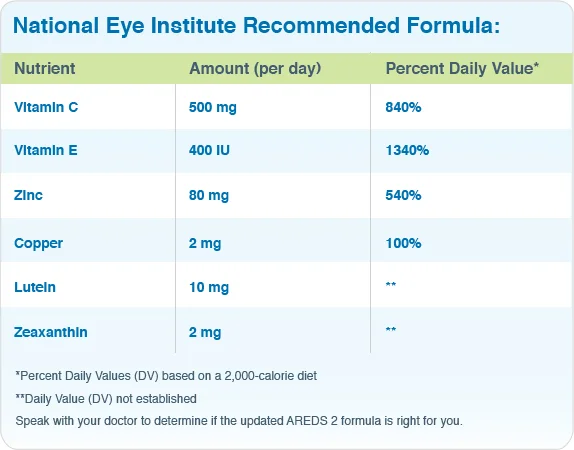
It is now believed that a key to managing age-related macular degeneration is a system of vitamin and mineral supplementation known as AREDS or AREDS2. Studies conducted by the National Institute of Health called the Age-Related Eye Disease Study (AREDS, followed by AREDS2) investigated whether daily use of certain vitamins and/or minerals may help delay the progression of AMD.
The formula recommended by the National Eye Institute includes high levels of antioxidants and zinc, which may help reduce the risk of advanced AMD vision loss by up to 25%. These supplements do not sufficiently benefit patients in early or intermediate stage dry macular degeneration, nor do they restore vision already lost to
Trusted Source
Age-Related Macular Degeneration
National Eye Institute
Go to Source
AMD.
Frequently Asked Questions About AMD
While it isn’t possible to prevent macular degeneration, you may be able to minimize your risk by:
- Exercising
- Eating a diet rich in Omega-3 fatty acids
- Having regular eye exams
Macular degeneration is part of the eye’s aging process, and roughly 30% of adults over the age of 75 are diagnosed with intermediate or advanced
Trusted Source
Age-Related Macular Degeneration: Facts & Figures
BrightFocus Foundation
Go to Source
stage AMD.
Additionally, some people may be at a higher risk of developing AMD. Risk factors for macular degeneration include:
- Genetics: Up to one-half of the cases where macular degeneration results in blindness occur in people with genetic variant complement factor H
- Gender: Females are more likely to develop AMD
- A family history of age-related macular degeneration
- Obesity
- Smoking
- A high-fat diet
- High cholesterol
- High blood pressure
- Insufficient exercise
- Extended sun exposure
- Certain medications
Unfortunately, there is no cure for macular degeneration. Although we can slow its progression, patients will still face some level of compromised vision. Low vision optical aids are often helpful for people with significant vision loss from macular degeneration. Magnifying devices including high-add spectacles, hand or stand magnifiers, telescopes, and closed-circuit television for viewing objects are some of the available resources.
Your Macular Degeneration Specialists






Contact Fraser Eye Care
For more information on macular degeneration and to schedule an examination by an experienced ophthalmologist, please contact us. We proudly serve patients from throughout the Detroit, Michigan area.
1 Cleveland Clinic. Retina. Available: https://my.clevelandclinic.org/health/body/22694-retina-eye#:~:text=The%20retina%20is%20made%20of,field%20(your%20peripheral%20vision). Accessed September 13, 2022.
2 American Academy of Ophthalmology. What is Macular Degeneration? Available: https://www.aao.org/eye-health/diseases/amd-macular-degeneration. Accessed September 13, 2022.
3 Cleveland Clinic. Age-Related Macular Degeneration. Available: https://my.clevelandclinic.org/health/diseases/15246-age-related-macular-degeneration. Accessed September 13, 2022.
4 American Academy of Ophthalmology. How is AMD Diagnosed and Treated? Available: https://www.aao.org/eye-health/diseases/amd-treatment. Accessed September 13, 2022.
5 National Eye Institute. Age-Related Macular Degeneration. Available: https://www.nei.nih.gov/learn-about-eye-health/eye-conditions-and-diseases/age-related-macular-degeneration. Accessed September 13, 2022.
6 BrightFocus Foundation. Age-Related Macular Degeneration: Facts & Figures. Available: https://www.brightfocus.org/macular/facts-figures. Accessed March 13, 2025.